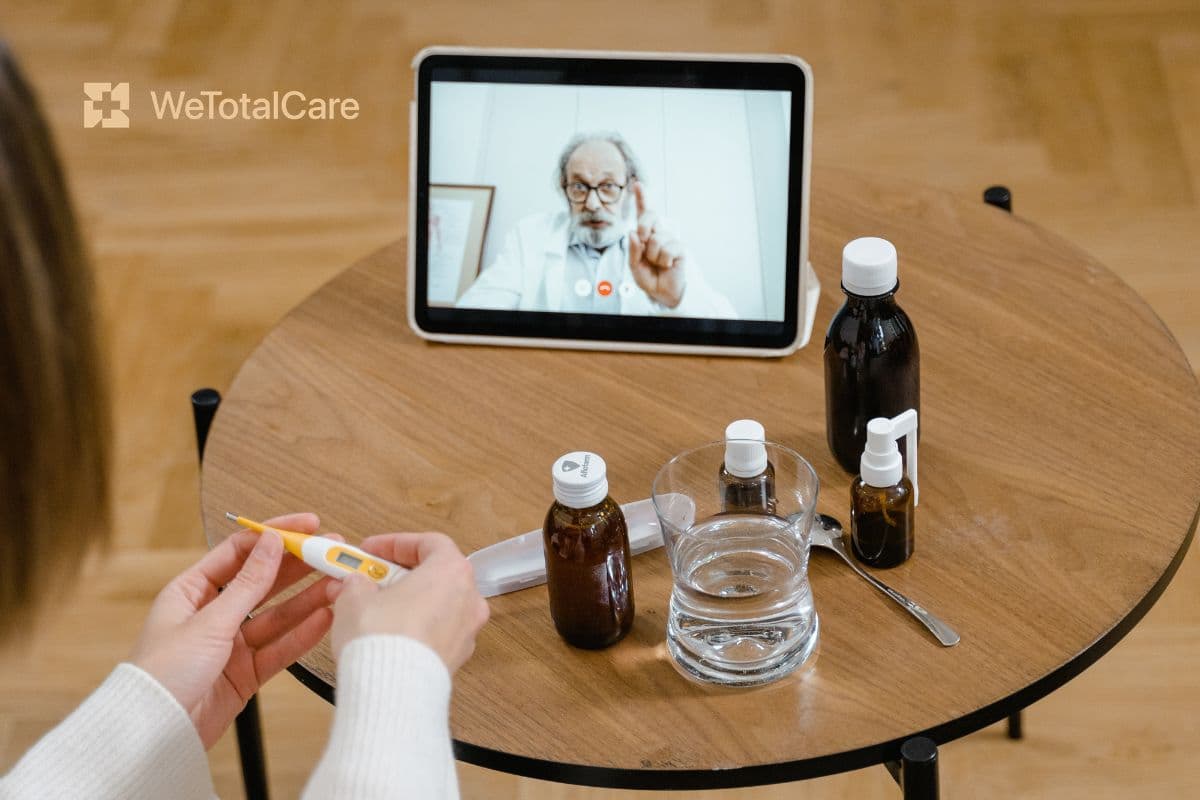
Three things nobody misses about getting sick: the waiting room, the drive there, and the bill that shows up afterward.
A virtual care membership deletes all three. You open an app instead of a lobby door. You talk to a licensed provider from your kitchen, not an exam room forty minutes away. And you pay one flat monthly fee instead of a copay-plus-surprise-invoice combo you can never predict.
So that's the pitch in one breath. What follows is the detailed version: what each of those three promises actually delivers, what comes bundled underneath, and where a membership stops being the right tool for the job.
No waiting room
Waiting rooms are a special kind of misery. You arrive on time and wait anyway, surrounded by other people's germs, watching the clock eat an afternoon you don't get back.
Numbers make it worse than it feels. Americans spend an average of two hours on a twenty-minute office visit, roughly forty minutes of that just getting there, and people who choose a video visit tend to get seen sooner than those booking in person (NIH). Most of the two hours is overhead, not care.
A membership collapses the whole thing. You connect with a provider in about five minutes, day or night, and the visit is just the visit, no lobby attached.
No germy waiting room, either. Skipping a room full of sick people is its own small health win. Flu season makes that matter more. So does bringing a kid who doesn't need to catch a second thing on top of the first.
No commute
Distance is the quiet barrier in healthcare. A specialist an hour away, a clinic across town with no parking, a pharmacy run tacked onto the end, all of it adds friction to something you already feel too lousy to do.
Care that travels with you erases the drive. WeTotalCare's providers cover all 50 states, so the visit happens wherever you are: your couch, a hotel room on a work trip, a dorm three time zones from home. A phone or laptop is the entire setup. Your prescription lands at whatever pharmacy sits closest to wherever you happen to be, turning the old pharmacy run into a two-minute pickup.
For anyone who can't easily get out, the gap is even wider. A parent stuck home with a sick toddler, someone without a car, a person in a rural county where the nearest clinic is a genuine drive, a shift worker who can't lose two hours midday. Distance stops deciding whether they get seen.
No copay
Here's the part your wallet notices. Every visit inside a membership costs $0. No copay at check-in, no coinsurance, no bill landing weeks later with a number you never agreed to.
You pay one flat monthly fee, starting at $24.99, and a visit always costs the same amount: nothing. Knowing the price up front changes behavior. People stop rationing care, stop talking themselves out of a visit to save $40, and deal with small problems before they turn into big ones.
Limits apply to that fee, though, and the next couple of sections spell them out.
Care that keeps up with real life
Traditional care runs on a doctor's-office clock. Nine to five, Monday through Friday, closed right when you finally have a minute to deal with yourself.
A membership flips that. Providers are there at 11 p.m., on a Sunday, over a holiday weekend, the hours illness actually keeps. You reach someone while the problem is happening, not three days later at the next open slot. WeTotalCare's how-it-works guide shows the whole flow from sign-up to visit.
Unlimited visits shift the rhythm too. Following up costs nothing, so people actually circle back to confirm they're healing instead of assuming it. A quick check two days after a diagnosis is free, which means it happens, which means fewer small things quietly turn into big ones.
What's actually included
Those three no's are the headline, but the inclusions are the substance, and they run well past 'talk to a doctor sometimes.'
Depending on the tier, telehealth membership benefits cover:
- Unlimited 24/7 urgent and primary care with licensed U.S. providers, every visit at $0, nights and weekends included
- More than 1,000 medications at $0 on the primary care tiers, sent to your pharmacy whenever a provider prescribes one
- A $0 annual lab panel, the once-a-year bloodwork that catches problems your body hasn't gotten around to mentioning
- Virtual dermatology, unlimited $0 messages to specialists, and on the family tier, unlimited behavioral health with a consistent counselor
An online doctor membership at the entry level runs leaner, built around on-demand urgent visits for $24.99 a month. Step up to primary care and the labs, medications, and specialist access come with it. WeTotalCare's membership overview breaks down each tier.
Member savings on dental, vision, and imaging round it out through participating discount networks, though those are savings, not insurance.
Meet your virtual primary care provider
A membership is only as good as the person on the other end of the call. So who is that?
Every visit connects you with a licensed U.S. provider, credentials shown before and during the consultation. On the primary care tiers, you build a real relationship with a virtual primary care provider over time, the same way you would with an in-person doctor: they learn your history, track what's working, and adjust as they go.
An online doctor visit itself is simple. You describe what's going on, share a photo if it helps, and the provider walks you through a plan. Prescriptions route to your pharmacy when medically appropriate, and federal health guidance lists the kinds of conditions a video visit handles well (HHS). Guidance and a good provider land on the same boundary: some things suit a screen, some don't.
Behind it, the platform holds LegitScript certification and runs HIPAA-compliant and encrypted, so the convenience doesn't cost you your privacy.
Is virtual care as good as being there?
Fair question, and the honest answer is: for the right problems, yes.
A large body of research finds telehealth outcomes as good as or better than in-person care, with the caveat that results depend on the condition and the patient (NIH). For the everyday complaints a membership handles, a sinus infection, a UTI, a rash, a medication check, a video visit does the job.
Virtual care is also well past niche. Roughly one in three people used telehealth in a recent survey year, so this stopped being an experiment a while ago (CDC).
Where it hits a wall is anything needing hands or hardware. A physical exam, a throat culture, an X-ray, an injury someone has to touch to understand. A good provider names that boundary out loud and sends you to in-person care rather than guessing through a screen. Patients tend to rate these visits well anyway, largely because the care is the same conversation with the logistics stripped out.
What a membership doesn't get you
Every honest pitch needs this section, so here it is.
A virtual care membership is not health insurance. Hospital stays, surgery, an ER trip, the six-figure bill after something serious, none of it is covered. Keep real coverage for the catastrophes and let the membership carry the everyday layer. Both work best together, never as substitutes.
Wellness programs sit outside the membership too. Weight management, hormone therapy, and the longevity treatments are priced per program, not folded into your monthly fee. Anyone joining expecting free weight-loss medication is reading it wrong.
And the discount extras, dental and vision and the rest, run through third-party networks that vary by location. Treat them as a bonus, never as coverage.
Who gets the most out of it
A membership pays off hardest for a few kinds of people.
- Anyone who values time, since skipping the commute and the waiting room hands back hours every year that care used to swallow
- People without insurance who want predictable everyday care instead of gambling on out-of-pocket clinic prices every single time
- Families juggling work and sick kids who need a provider at odd hours without loading everyone into the car
- Frequent travelers, remote workers, students, and anyone whose life refuses to fit inside a clinic's nine-to-five window
People who benefit least are just as clear: anyone who needs regular hands-on care, and anyone hoping a membership will stand in for real insurance. Neither works out, and the membership doesn't pretend otherwise.
Questions worth asking
What's actually included in a virtual care membership?
Depends on the tier. Every plan includes unlimited 24/7 virtual visits at $0, and the primary care tiers add labs, more than 1,000 $0 medications, dermatology, and specialist messaging. Family coverage layers in behavioral health for the whole household.
Do I see the same provider each time?
On the primary care tiers, that's the goal. You build a relationship with a consistent virtual primary care provider who learns your history and follows your progress, rather than starting over with a stranger every visit.
Is an online doctor visit as good as seeing someone in person?
For the conditions these visits are built for, research says outcomes hold up well against in-person care. A provider tells you plainly when your symptoms need a physical exam and routes you there. Knowing that line is part of good care, not a limitation of it.
Does an online doctor membership replace my insurance?
Not at all, and it isn't meant to. A membership handles everyday care while insurance covers catastrophic events. Most members keep both, which tends to beat leaning on either one alone.
How fast can I actually see someone?
About five minutes on average, any hour of the day. Nights, weekends, and holidays are all staffed, so care doesn't wait for business hours to reopen.
What if I need a prescription?
A provider can send one to your pharmacy when it's medically appropriate for you. Higher tiers include more than 1,000 medications at $0, while the entry tier sends prescriptions at standard retail price. Nobody gets one just for asking. More detail sits on the FAQ page.
Bottom line
Strip away the jargon and a virtual care membership gets you three things insurance makes weirdly hard: fast care, care from anywhere, and a price you can actually predict. Underneath sit the real telehealth membership benefits: primary care, labs, medications, and a provider who knows you.
None of it replaces insurance for the big emergencies. All of it handles the everyday care that makes up most of what a household actually needs.
Compare the tiers, keep your catastrophic coverage, and pick the everyday layer that fits on the membership plans page. Any questions go to the contact page.



Medical disclaimer
This article is for general educational purposes only and is not medical advice, a diagnosis, or a treatment recommendation. It is not a substitute for care from a qualified professional. Prescription treatments are available only after evaluation by a licensed provider, who determines whether a therapy is appropriate for you. Individual results vary. If you have a medical emergency, call 911.
Talk to a licensed provider
See what's right for you, virtual care from $24.99/mo.